
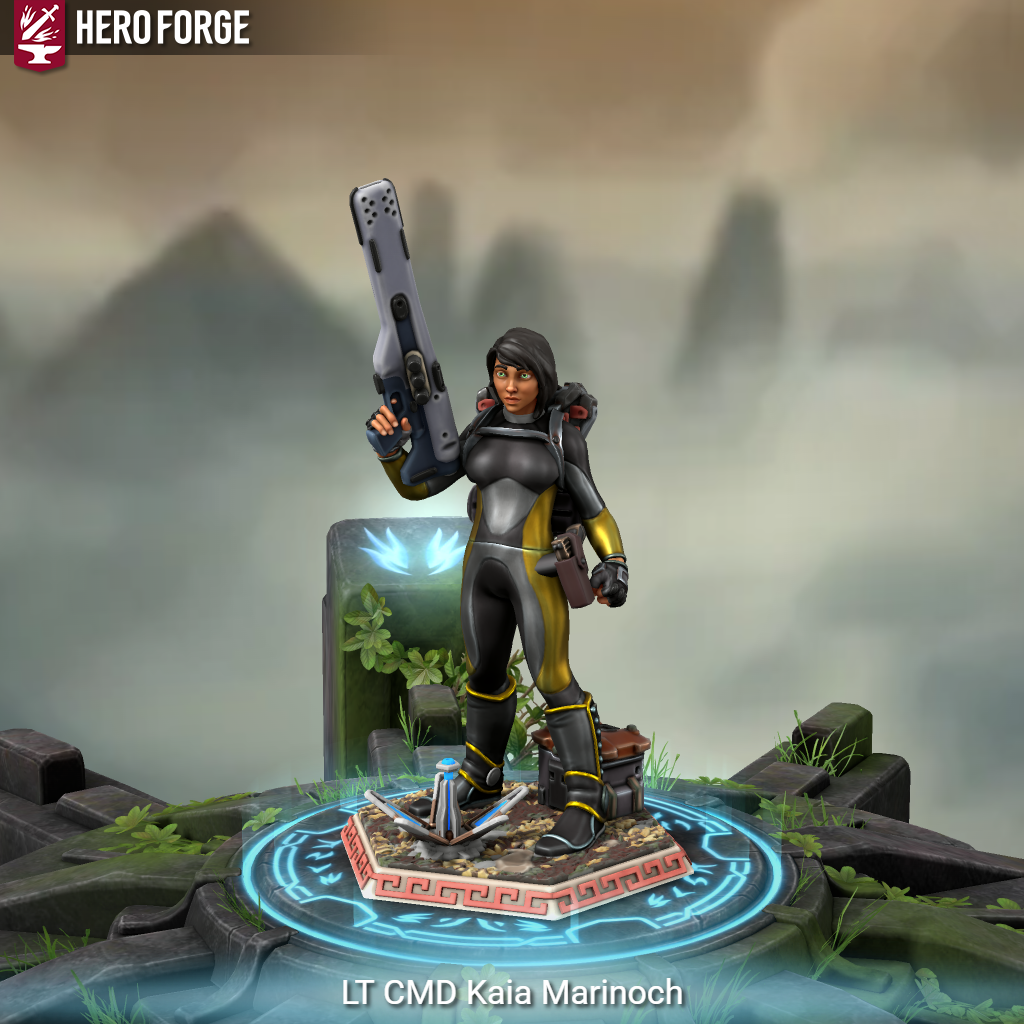
Following the events of the Vermillion Incident, the newly formed V.I.P.E.R. Initiative was thrust into the public spotlight by being instrumental to the defeat of the insurrectionist forces. To help put a face to the Initiative, Heliosphere New Service reporter Evaelyn Conway caught up with Viper Agent Kaia Marinoch as she returned from her patrol out along the Lysian Way.
[Evaelyn Conway] What motivated you to join the V.I.P.E.R. Initiative?
[Kaia Marinoch] Ever since I was a little girl, I’ve been driven to explore the stars. That was why I joined the military to begin with. Being a Viper agent just adds to that. Not only do I get to serve the Emperor, but I also get to see so many more worlds then if I was still in the regular Navy.
[EC] Can you describe the selection process?
[KM] Most of the qualification process is classified, but I can speak to parts of it. Viper Agents are selected from the best and brightest from across the Imperium’s military branches. For example, I was pulled from the Navy. Once you accept the invitation, you go through Qualification where they weed out those not suited to be Viper Agents. Once you qualify, all potential Viper Agents go through an Operator Training Course. OTC teaches you everything you will need to know and allows you to gain experience as part of a special forces team. Only those who pass OTC become Viper Agents.
[EC] What challenges did you face during your training, and how did you overcome them?
[KM] Without going into specifics, there were times during Qualification where I thought about quitting. One time in particular, I was actually on my way to resign. I would have too, had not fate intervened.
[EC] What aspects of your military background prepared you for being a Viper Agent?
[KM] Honestly? Nothing. This role is so far beyond anything I’ve done that it’s not comparable. Sure, there are specific skills that I use every day, like commanding a starship, but the situations around them are all different.
[EC] What was the hardest part of transitioning from general military service to Special Forces?
[KM] The regular military is all about discipline and regulations. The Special Forces are all about adaptability. The hardest part of the transition was getting used to the relaxed regulations that I’ve spent years getting used to. Even things like grooming standards. You just get so used to living within the box that you forget how to live outside of it.
[EC] What is the most difficult part of Special Forces work for you personally?
[KM] The killing. It’s kind of ironic for a supposedly cold blooded killer to say that…but it’s true. I was born in Saint’s Harbour. We value pacifism above all else. That aspect of my upbringing is still very strong in me. So I do my best to try and avoid killing whenever possible.
[EC] Have you killed anyone?
[KM] Yes. That is an unfortunate part of this role.
[EC] How do you handle the physical and mental strain that comes with such a demanding job?
[KM] I don’t know. We all just do. All Viper Agents are selected from the pool of the population that is naturally able to handle such strains. And Qualification ensures those that can’t are removed.
[EC] What has been the most rewarding experience in your career so far?
[KM] I’d have to say it’s the ability to serve the Immortal Emperor directly. At the end of the day, he has direct authority over Viper Agents. After all that he has done to keep us safe and guide us, I feel like it is my duty to ensure his domain stays safe for all his subjects.
[EC] Can you share a particular mission that stands out in your mind and why?
[KM] Unfortunately, while not all our missions are not classified, we are not at liberty to speak about them.
[EC] How do you balance the demanding nature of Viper work with personal life and relationships?
[KM] As a former Navy officer, I already came to terms that the service is my life. With so many long deployments, it’s impossible to maintain any kind of long term relationship.
[EC] You said you are from Saint’s harbour. Have you experienced any bias or discrimination during your time in the Special Forces? If so, how did you deal with it?
[KM] Yes, especially early in my career. At the end of the day, I just try to do my job as best as I can with the knowledge that everyone is different and not everyone holds those views. Even so, some days it can be difficult.
[EC] What is the most critical skill for a Special Forces operative to possess?
[KM] I would have to say the most critical skill for any Special Forces operative is the ability to adapt to ever changing situations. The one thing you can be sure is that no plan survives contact with the enemy. Add to that the unique situations we get put in and you have a recipe for challenging missions.
[EC] How do you handle the pressure of knowing that your actions could be a matter of life or death for you and your team?
[KM] The same way all soldiers do, through training and repetition. You can’t let your mind freeze mid-combat. So the best way to help protect your team is to make sure you are the best at what you do.
[EC] How do you train for specific cultural and linguistic differences when deploying to foreign nations?
[KM] This is actually a critical part of Viper training. I came into the program knowing multiple languages. But as part of OTC, all members must learn at least one additional language and be able to understand two others. While everyone has access to a translator implant, you never know when it will malfunction or be unavailable.
[EC] What are the biggest misconceptions people have about what Special Forces operatives actually do?
[KM] The biggest misconception is that we are all super strong and super fast killing machines. In fact, Viper operatives are chosen just as much for their intelligence and endurance as strength.
[EC] What advice would you give anyone who aspire to join the Special Forces?
[KM] Work on your studies. Every member of a Viper team has a secondary specialization. Medical, linguistics, explosive, computer science, or engineering. You’d be surprised how many missions require these skills to be successfully completed.
[EC] Well, thank you for your time, Lieutenant Commander.
[KM] Any time.
If you would like to know more about the V.I.P.E.R. Initiative, we encourage our readers to visit the Encyclopedia Galactica.